Breville Barista Express vs Gaggia Classic Pro
Every beginner espresso thread eventually collapses into the same fork: the Breville Barista Express or the Gaggia Classic Pro. Most comparisons stop at “Breville has a built-in grinder, Gaggia is more upgradeable” — true, and useless, because it never explains why the two machines feel completely different to live with.
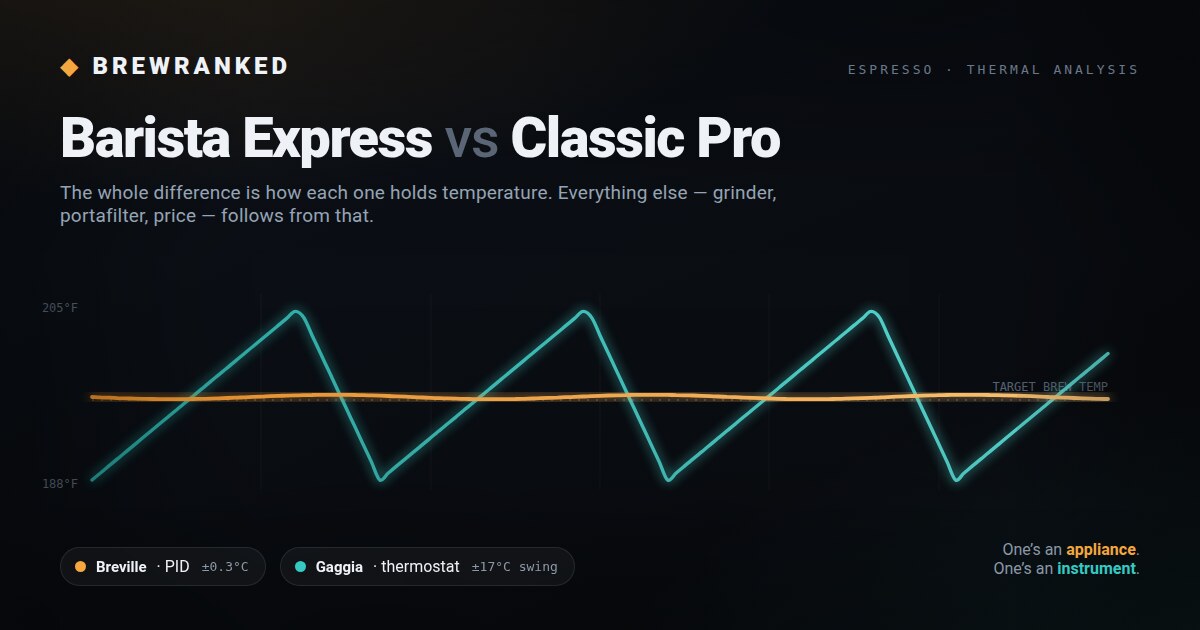
They feel different because they were built around opposite philosophies of a single problem: how to keep brew water at the right temperature. Everything else — the grinder, the portafilter size, the price you’ll actually end up paying — follows from that one decision. So that’s where we’ll start.
| Spec | Breville Barista Express | Gaggia Classic Pro |
|---|---|---|
| Heating | Thermocoil + PID | Single boiler, no PID |
| Portafilter | 54mm | 58mm (commercial) |
| Grinder | Built-in conical burr | Not included |
| Power | 1600W | 1300W |
| Best for | One-box beginners | Upgraders & tinkerers |
| Rating | ★★★★⯨ | ★★★★☆ |
| Buy | Buy | Buy |
Breville Barista Express vs Gaggia Classic Pro — at a glance
The real difference: how each one holds temperature
Espresso is brutally sensitive to brew temperature — a few degrees is the difference between sour and balanced. How each machine solves that is the whole story.
The Breville uses a thermocoil with electronic PID control. Water is heated on demand as it passes through, and a small controller holds it at a target (200°F by default, adjustable ±4°F in 2°F steps, per Breville’s own spec). Practically: it’s ready in about 30 seconds and the temperature is managed by software, shot to shot. It also runs a low-pressure pre-infusion before ramping to a 9-bar extraction, which gently settles the puck and reduces channelling — the single most common beginner mistake.
The Gaggia Classic Pro takes the opposite route: a small single boiler (100ml, aluminum on the original Classic Pro; brass on the newer Classic Evo Pro E24) governed by a physical bimetal thermostat — no factory PID. That thermostat is simple and durable, but it swings. As documented extensively by the home-barista modding community, a stock Classic can drift by up to ~17°C across a single heating cycle. That’s why long-time owners “temperature surf”: they time the shot against the boiler’s heating rhythm to catch the right moment.
This is the crux nobody spells out:
- The Breville removes the temperature problem for you. Forgiving, consistent, low skill floor.
- The Gaggia hands you the temperature problem. Punishing at first — but once you learn to surf it (or spend ~$1 in parts and a weekend adding a PID, which holds it to roughly ±0.3°C), you have total control.
One is an appliance that makes good espresso. The other is an instrument you learn to play.
Portafilter: 54mm vs 58mm is not about “bigger”
The Breville is 54mm; the Gaggia is 58mm — the true commercial standard used on café machines. Two consequences most guides skip:
- Puck geometry. For the same 18g dose, the narrower 54mm basket forms a deeper, narrower puck than the 58mm. Water has to travel through more coffee depth, which changes how flow and channelling behave. The 58mm’s wider, shallower bed is what the entire café world dials in around.
- The ecosystem. 58mm is a universe: bottomless portafilters, precision IMS baskets, dosing funnels, WDT tools, tampers — endless and cheap. The 54mm world exists but is smaller and pricier. If your plan is to tinker and upgrade accessories, 58mm is a wide-open door; 54mm is a narrower one.
The Gaggia also carries a 3-way solenoid valve — it dumps line pressure the instant the shot ends, giving you a dry, cake-like puck you can knock out immediately. It’s a small commercial-grade touch the Breville doesn’t replicate, and owners consistently note it as one of those “feels like a real machine” details.
The grinder decides everything — and only one machine includes it
Here’s the truth that reframes the whole price comparison: the grinder, not the espresso machine, is where espresso quality is actually made. Grind consistency governs extraction more than any feature on either boiler.
- The Breville builds in a conical burr grinder with integrated dosing. It’s genuinely convenient and good enough to make excellent espresso — the entire setup lives in one box on one footprint.
- The Gaggia includes no grinder. You must pair it with a dedicated one, and that’s both its weakness and its strength: a good standalone grinder (say, a Baratza Encore ESP as an entry point, or better) will typically out-grind the Breville’s built-in unit — sharper, more repeatable, easier to single-dose — at the cost of money and counter space.
So the honest framing isn’t “Breville $X vs Gaggia $Y.” It’s:
Breville = machine + grinder, one price, one box. Gaggia = machine + (a grinder you must buy) + (optional PID) + (optional accessories).
Total cost of ownership, and the ceiling that matters more
Add a decent grinder and a PID to the Gaggia and you can land at or above the Breville’s price. On day one, the Breville is often the better value. But the two setups have very different ceilings:
- The Breville’s ceiling is roughly where it ships. It’s excellent and self-contained, and you’ll rarely modify it. When you outgrow it, you replace it.
- The Gaggia’s ceiling is far higher. PID, a bottomless portafilter, IMS baskets, steam-wand and OPV mods, and any 58mm accessory ever made — owners routinely evolve a Classic over years into something that punches well above its price. You don’t replace it; you upgrade it.
Steam and milk drinks
Both are single-boiler machines, so both make you wait to switch between brewing and steaming, then wait again to come back down — expect a short pause between pulling a shot and steaming milk. The Gaggia’s commercial-style steam wand is well-regarded among single boilers for producing proper microfoam once you learn it; the Breville’s wand is more approachable but a touch less powerful. Neither is a milk-drink machine for a crowd — for back-to-back lattes you’d want a dual boiler, which is a different budget entirely.
Who should buy which
Buy the Breville Barista Express if you want to make genuinely good espresso this weekend with the shortest possible learning curve, you value one box on one footprint, and you’d rather the machine manage temperature and pre-infusion for you. It’s the lower-risk, higher-floor choice.
Buy the Gaggia Classic Pro if you already own (or will buy) a real grinder, you want to learn the craft, and you like the idea of a durable, endlessly upgradeable 58mm platform you’ll keep and improve for years. It’s the lower-floor, higher-ceiling choice — and the one enthusiast reviewers keep circling back to as the standard prosumer entry point.
The verdict
This isn’t a machine that beats a machine — it’s a philosophy that fits you, or doesn’t. The Breville is the better appliance: it hides espresso’s hardest variables so you succeed immediately. The Gaggia is the better instrument: it exposes those variables so you can eventually master them. Neither is wrong; the mismatch is only ever between the machine and the person.
Every judgment here is built from published specifications and the aggregated, documented experience of owners and modding communities — never our own lab. See exactly how we build these calls.
Frequently Asked Questions
Which one makes better espresso out of the box?
For most beginners, the Breville — its PID and pre-infusion remove two of the biggest variables (temperature drift and channelling) with no learning curve. The Gaggia can match or beat it in the cup, but only after you master temperature surfing or add a PID.
Do I really need a separate grinder for the Gaggia?
Yes. The Gaggia has no grinder at all. Budget for a dedicated espresso grinder before anything else — the grinder, not the machine, is where espresso quality is actually decided.
Is the Gaggia's aluminum boiler a problem?
The original Classic Pro uses a 100ml aluminum boiler; the newer Classic Evo Pro (E24) switched to brass. Brass holds temperature more steadily, which reduces (but does not eliminate) the surfing routine. Confirm which version you are buying.